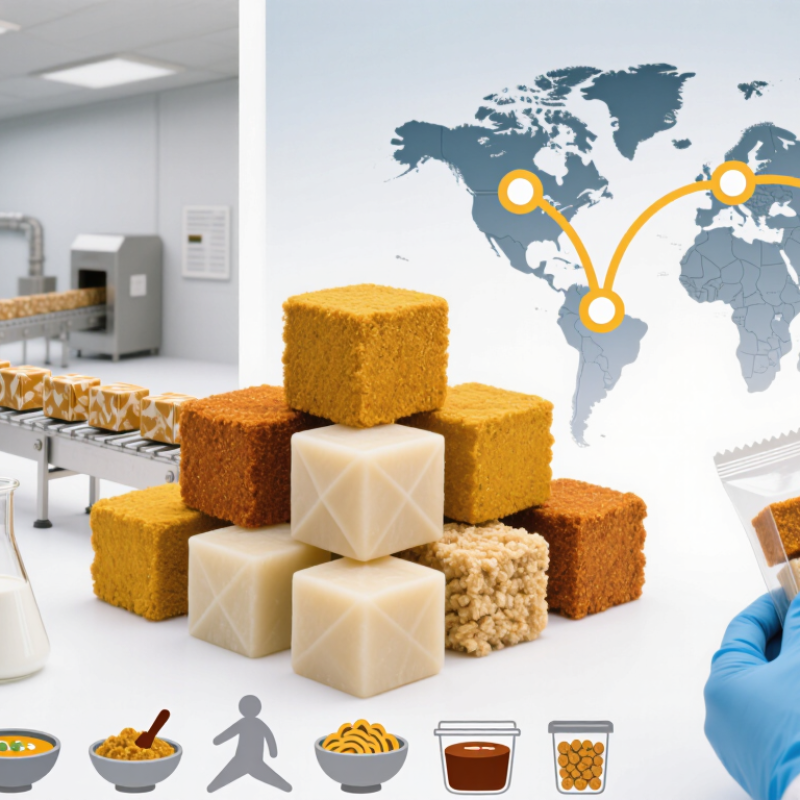
The 2026 market for Chicken Seasoning Cubes reflects changing expectations in taste, safety, convenience, and responsible sourcing. Manufacturers worldwide are improving recipes for soups, rice, noodles, sauces, and home cooking. Yet product quality depends on more than a strong aroma or attractive packaging.
This guide examines leading manufacturers through practical and professional criteria. These include ingredient control, flavor consistency, cube structure, factory hygiene, packaging performance, and international supply capability. A reliable cube should dissolve evenly in hot liquid. It should also provide balanced savory notes without overwhelming saltiness. Clear labels matter.
Manufacturing experience remains important. Established producers often understand regional preferences, moisture control, and large-volume production. However, newer companies may offer cleaner formulations, flexible private-label services, or more responsive development teams. No single supplier fits every buyer.
The comparison also considers certifications, traceability, laboratory testing, and customer support. These details can reveal how a manufacturer manages daily production risks. A cracked cube, a weak seal, or an inconsistent batch can damage trust quickly. Small issues matter.
Public information is not always complete. Some manufacturers disclose detailed factory standards, while others provide only basic product descriptions. Therefore, buyers should verify certificates, samples, technical sheets, and audit records before making decisions. Rankings can change as capacity, ownership, and market performance develop.
This overview aims to support informed supplier evaluation in 2026. It is not a substitute for independent quality checks. Careful judgment remains necessary.
Global chicken seasoning cube rankings for 2026 should begin with market scope, not advertising visibility. The category includes bouillon-style cubes used in homes, restaurants, foodservice kitchens, and packaged meal production. Definitions differ across market reports, which makes direct comparisons imperfect. Grand View Research and Mordor Intelligence both identify convenience foods, urbanization, and processed poultry demand as important growth drivers. However, their market boundaries and revenue estimates are not identical.
The 2026 ranking criteria should combine measurable performance with regional relevance. Suggested weights include product safety and quality systems at 25%, international distribution at 20%, manufacturing capacity at 15%, ingredient transparency at 15%, consumer acceptance at 15%, and innovation at 10%. FAOSTAT data shows the continuing scale of global poultry production, while the OECD-FAO Agricultural Outlook 2024–2033 expects poultry to remain a major source of future animal-protein supply. That supports demand potential, but it does not prove every manufacturer deserves a high rank. Evidence matters.
Tips: Check audited certifications, export records, sodium disclosure, batch consistency, and heat stability. Test cubes in broth and rice dishes. Laboratory data alone can miss texture and aroma changes during cooking.
A stronger ranking should separate worldwide reach from local strength. A smaller producer may perform better in regional taste adaptation or supply reliability. I would also review complaint rates, recall history, packaging durability, and climate-related supply risks. Reported figures can be incomplete. That limitation should remain visible.
2026 Top Chicken Seasoning Cubes Manufacturers Worldwide
In 2026, leading manufacturers are judged by capacity, revenue stability, and regional reach. Large production lines support consistent cube size, aroma, and salt distribution. However, capacity alone can mislead buyers. Some factories operate below their stated output during seasonal demand. Revenue trends offer another useful signal. Strong results may reflect pricing, not genuine volume growth. Experienced buyers should compare audited figures, factory certifications, export records, and repeat-order performance. Plant visits can reveal practical details, including packaging flow, storage conditions, and quality-control routines.
Tips: Request three years of capacity data. Check whether figures represent installed or actual output. Ask for regional delivery times, minimum order quantities, and contingency plans. Sample cubes after storage, not only after production.
Regional reach also separates dependable suppliers from ambitious newcomers. Manufacturers serving Africa, Asia, Europe, and the Americas usually understand different taste profiles and labeling requirements. They may maintain regional warehouses or qualified distribution partners. Still, global coverage does not guarantee smooth service. Currency shifts, freight delays, and local registration rules can affect delivery. I would score suppliers using weighted criteria, rather than choosing the highest revenue figure. A smaller producer may respond faster and customize formulas better. Forecasting remains imperfect, especially when poultry consumption changes unexpectedly. That weakness deserves honest review.
Chicken seasoning cube production begins with inspected poultry bones, meat trimmings, and skin. Suppliers must document origin, temperature, and handling conditions. In controlled vessels, these ingredients simmer with water to release savory proteins, collagen, and natural poultry flavor. Fat separation follows, often through centrifugation or chilled settling.
The clarified extract is concentrated under vacuum. This reduces water while protecting delicate aromas from excessive heat. Technologists then blend it with salt, starch, spices, vegetable powders, and permitted flavor components. Moisture control matters greatly. Too much water weakens the cube, while excessive drying can create a dusty texture. Small mistakes show quickly.
The blend passes through a forming machine, where measured portions are compressed into uniform cubes. Some producers use gentle heating before pressing, depending on formulation and equipment. Each batch requires checks for weight, moisture, salt distribution, microbial safety, and dissolution time. A cube should break down in hot water without leaving hard fragments. Packaging must block humidity, oxygen, and light. Foil laminates or sealed moisture barriers are common choices. Shelf stability depends on the whole chain, not one ingredient. Even experienced manufacturers revisit formulas when poultry extracts vary by season, breed, or processing condition. That variability is easy to underestimate. There is no perfect batch.
In 2026, leading chicken seasoning cube manufacturers worldwide are judged by food safety discipline, not attractive packaging. Codex guidance supports clean processing, controlled ingredients, and reliable hygiene practices. Buyers should check whether factories control moisture, heat, allergens, and microbial risks during production. Small details matter, including sealed powder rooms and clean sampling tools.
WHO food safety principles encourage practical controls from raw materials to final storage. A responsible manufacturer verifies supplier documents, tests spices for contamination, and protects products from cross-contact. Workers need visible handwashing stations, protective clothing, and clear illness procedures. Keep records carefully. A missing temperature log can weaken an otherwise strong safety program.
ISO 22000 adds a structured management system around hazard analysis, prerequisite programs, traceability, and corrective action. Auditors should follow one batch backward, from finished cube to salt, fat, seasoning, and packaging records. Independent laboratory testing can support, but never replace, factory controls. Certification alone is not proof of daily performance. No checklist is perfect. Some facilities still overlook condensation above open mixers or delayed allergen cleaning. That deserves honest review, not polished claims. Manufacturers that investigate these gaps, document decisions, and improve repeatedly show stronger reliability across international supply chains.
| Assessment Dimension | Benchmark or Requirement | Reference Basis | Recommended Evidence for Manufacturer Assessment | Benchmark Status |
|---|---|---|---|---|
| Food Safety Management System | Documented, implemented, maintained, and continually improved food-safety management processes covering the full production chain. | ISO 22000:2018 clauses covering context, leadership, planning, support, operation, performance evaluation, and improvement. | Current certificate scope, internal-audit records, management-review minutes, corrective-action records, and documented objectives. | Core benchmark |
| HACCP-Based Hazard Control | Hazards should be identified, evaluated, controlled, monitored, verified, and documented through a HACCP-based system. | Codex CXC 1-1969, General Principles of Food Hygiene, including the HACCP system and its seven principles. | Hazard analysis, process flow diagram, critical control point rationale, critical limits, monitoring forms, verification plan, and deviation records. | Core benchmark |
| Prerequisite Programs | Good hygiene practices should be established before HACCP implementation, including sanitation, pest control, maintenance, personnel hygiene, and supplier control. | Codex CXC 1-1969 and ISO 22000:2018 prerequisite-program requirements. | Sanitation standard operating procedures, cleaning validation or verification, pest-control reports, maintenance logs, hygiene inspections, and approved-supplier procedures. | Core benchmark |
| Raw-Material Approval | Ingredients such as salt, spices, chicken-derived materials, flavor enhancers, starches, and packaging materials should be purchased against defined specifications. | Codex hygiene principles and ISO 22000 operational planning and control requirements. | Supplier approval list, ingredient specifications, certificates of analysis where applicable, incoming inspection records, and supplier-performance reviews. | Core benchmark |
| Allergen Management | Allergens intentionally used in the recipe or introduced through cross-contact should be identified, controlled, and accurately declared according to the destination market. | Codex General Standard for the Labelling of Pre-packaged Foods, CXS 1-1985, together with Codex hygiene principles. | Allergen matrix, segregation or sequencing controls, validated cleaning procedures, label approval records, and change-control documentation. | Core benchmark |
| Microbiological Safety | Finished products and relevant environmental areas should meet applicable legal and customer microbiological criteria, with sampling based on risk. | Codex principles for microbiological control and applicable national or regional microbiological criteria; limits vary by jurisdiction and product formulation. | Risk-based sampling plan, laboratory results, environmental-monitoring trends, investigation reports, and documented release decisions. | Legal-market dependent |
| Pathogen Control | Controls should address relevant hazards associated with spices, animal-derived ingredients, dry-mix handling, post-process contamination, and moisture ingress. | Codex HACCP principles and WHO food-safety guidance; specific controls depend on the validated process and formulation. | Validated process controls, supplier risk assessments, environmental monitoring, pathogen trend analysis, and documented corrective actions. | Risk-based benchmark |
| Moisture and Water Activity | Dry seasoning cubes should be protected from moisture pickup and monitored against product specifications established through shelf-life and safety studies. | Product-specific prerequisite and HACCP controls under Codex and ISO 22000; Codex does not prescribe one universal water-activity limit for all seasoning cubes. | Validated moisture or water-activity specification, calibrated test equipment, batch-release records, packaging-integrity checks, and trend analysis. | Product-specific |
| Foreign-Material Control | Facilities should prevent, detect, and manage physical hazards from equipment, packaging, raw materials, and the production environment. | Codex General Principles of Food Hygiene and ISO 22000 hazard-control requirements. | Glass-and-brittle-plastic register, sieve or magnet checks where applicable, metal-detector verification, equipment inspections, and incident records. | Core benchmark |
| Packaging Integrity | Packaging should protect the product from contamination, moisture, oxygen, light, and physical damage throughout intended storage and distribution. | Codex hygiene principles and ISO 22000 control of externally provided processes, products, and services. | Packaging specifications, seal or closure checks, transport simulations where justified, storage-condition records, and complaint analysis. | Core benchmark |
| Traceability | Each production lot should be traceable to significant ingredient and packaging inputs and to the immediate distribution stage. | ISO 22000:2018 traceability requirements and Codex food-hygiene principles. | Lot-coding system, one-step-back and one-step-forward exercise results, mass-balance records, and traceability-test completion times. | Core benchmark |
| Recall and Withdrawal Readiness | Documented procedures should enable rapid product withdrawal or recall when a food-safety risk or legal nonconformity is identified. | ISO 22000 emergency preparedness and response requirements; Codex principles for corrective action and food control. | Mock-recall reports, contact lists, decision trees, effectiveness checks, regulator-notification procedures, and post-event reviews. | Core benchmark |
| WHO Five Keys to Safer Food | Operational practices should reflect: keep clean; separate raw and cooked; cook thoroughly where applicable; keep food at safe temperatures; and use safe water and raw materials. | WHO, Five Keys to Safer Food, published as a global food-safety education framework. | Employee training records, hygiene observations, segregation controls, validated cooking or heat-treatment records where applicable, and water-quality documentation. | Practical benchmark |
| Potable Water and Utilities | Water, ice, steam, compressed air, and other utilities that may contact product or food-contact surfaces should be suitable for their intended use. | Codex General Principles of Food Hygiene and ISO 22000 prerequisite-program principles. | Water-quality test results, utility-risk assessment, treatment and maintenance records, sampling plan, and deviation investigations. | Core benchmark |
| Personnel Competence | Personnel should be competent for assigned food-safety responsibilities and receive appropriate hygiene, HACCP, allergen, and emergency training. | ISO 22000 competence and awareness requirements; WHO Five Keys to Safer Food. | Training matrix, competency evaluations, induction records, refresher-training schedule, and supervisor observation records. | Core benchmark |
| Calibration and Measurement | Measuring equipment used for food-safety decisions should be identified, calibrated or verified, protected from damage, and supported by suitable records. | ISO 22000 monitoring, measurement, analysis, and evaluation requirements. | Calibration certificates, verification checks, equipment inventory, out-of-tolerance assessments, and impact evaluations on affected batches. | Core benchmark |
| Internal Audit and Verification | Food-safety controls should be periodically audited and verified to confirm that planned arrangements are implemented and effective. | ISO 22000 performance-evaluation requirements and Codex HACCP verification principle. | Audit program, auditor competence records, findings classification, corrective-action closure, verification results, and management review. | Core benchmark |
| Regulatory and Label Compliance | Product formulation, additive use, nutrition information, allergen declarations, lot identification, and shelf-life information should comply with the target-market rules. | Codex labelling and food-additive standards, plus applicable national or regional legislation. | Regulatory review checklist, approved artwork, formulation-change control, label reconciliation, and market-specific compliance assessment. | Market dependent |
| Continuous Improvement | Nonconformities, complaints, incidents, audit findings, verification results, and performance trends should drive corrective and preventive improvement. | ISO 22000:2018 improvement requirements and Codex HACCP corrective-action principle. | Root-cause analysis, corrective-action effectiveness checks, complaint trends, food-safety objectives, and documented improvement projects. | Core benchmark |

2026 Top Chicken Seasoning Cubes Manufacturers Worldwide
Ingredient Trends, Sodium Data, and Sustainability Indicators in 2026
Chicken seasoning cube manufacturers are reformulating recipes around recognizable ingredients. Yeast extracts, dried mushroom, roasted onion, garlic, and fermented vegetable powders are gaining attention. These ingredients can strengthen savory depth without relying only on salt. Some producers also use turmeric, black pepper, and celery seed for color and aroma. Clean-label expectations are rising, but “natural” does not automatically mean better nutrition. Taste still matters.
Sodium remains a key purchasing measure in 2026. Many new formulations target reductions of 15% to 30% compared with conventional cubes. However, sodium values must be checked per serving and per 100 grams. Serving sizes differ widely across markets. Independent laboratory testing offers stronger evidence than front-pack claims. Reduced salt can also weaken broth intensity. The trade-off is real. Some recipes need extra time, spices, or umami ingredients to recover balance.
Sustainability assessments now examine more than recyclable wrappers. Buyers are tracking palm oil sourcing, agricultural traceability, factory energy use, water consumption, and food waste. Lightweight packaging can reduce transport emissions, yet its recycling value depends on local systems. Manufacturers with supplier audits and measurable carbon data appear more credible. Still, lifecycle boundaries can make comparisons unfair. Data needs context. A responsible review should question unclear claims, verify technical documents, and consider both nutritional performance and environmental impact.
Ingredient Trends, Sodium Data, and Sustainability Indicators in 2026
This category-level benchmark uses public sodium reference points rather than company or brand data. Sodium reduction, yeast extract, vegetable powders, starch-based binders, recyclable packaging, responsible palm-oil sourcing, and carbon-footprint reporting are key evaluation themes for chicken seasoning cubes in 2026.
Reference points: U.S. FDA sodium definitions and World Health Organization guidance recommending less than 2,000 mg of sodium per day for adults. Sustainability indicators are screening criteria, not market-share measurements.