
Choosing a China Best Plastic Food Container Supplier requires more than comparing prices or browsing polished product pages. Food packaging must protect meals, survive transport, and meet documented food-contact requirements. A practical evaluation should examine resin type, production controls, mold quality, sealing performance, and traceability. Small details matter, such as a warped lid, a sharp rim, or a container that stains after one tomato-based meal.
Industry data shows why this decision deserves careful attention. The OECD’s Global Plastics Outlook reports that global plastic waste reached 353 million tonnes in 2019, with packaging representing about 40% of total plastic waste. Its findings place pressure on suppliers to improve material efficiency, durability, and end-of-life planning. UNEP’s 2023 Turning off the Tap report also states that plastic pollution could be reduced by 80% by 2040 through reuse, recycling, and better product design. These reports do not make plastic packaging automatically sustainable. They highlight the need for measurable improvements.
An experienced buyer should request material specifications, food-contact test reports, migration testing, batch records, and production samples. Factory audits can reveal whether quality depends on one skilled operator or a stable system. Certifications are useful, but they never replace independent verification. The best Plastic Food Container supplier may not offer the lowest quotation. A slightly thicker wall, reliable sealing machine, or clearer documentation can reduce returns and waste. No supplier is perfect. That is why a balanced review should examine performance, compliance, communication, customization, and long-term responsibility before making a purchasing decision.
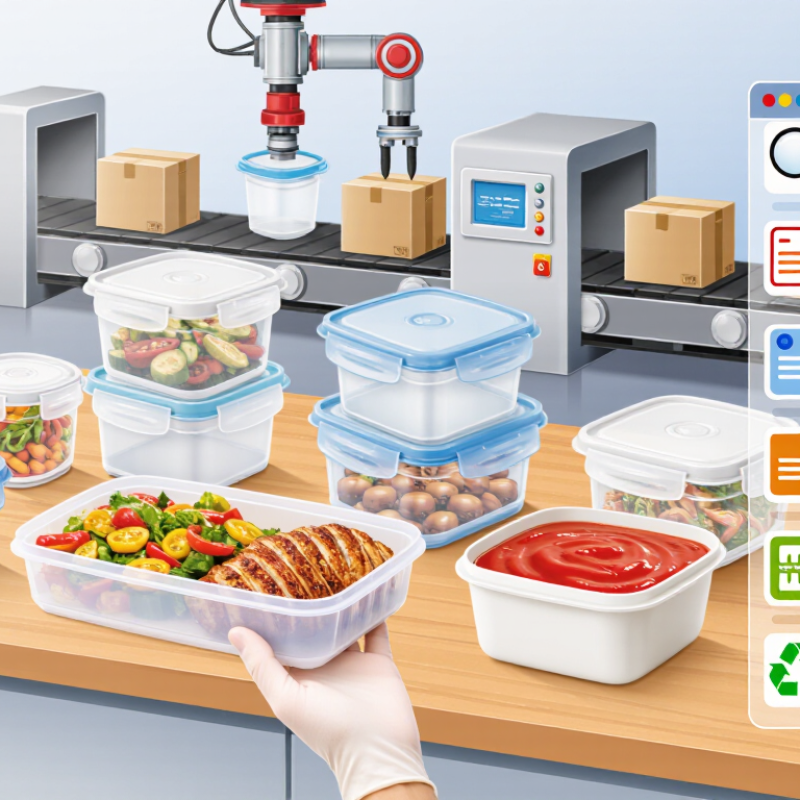
The best plastic food container supplier in China is defined by controlled evidence, not the lowest quotation. In 2023, global plastics production reached 413.8 million tonnes, according to PlasticsEurope’s Plastics—The Fast Facts 2024. That scale makes material control essential. A capable supplier should provide resin specifications, production-batch records, and food-contact test reports. For the Chinese market, testing should align with GB 4806.7-2023. Export projects may also require destination-specific migration testing. Certificates alone are not enough. Audit the factory floor, not just the document folder.
Product consistency matters in daily use. Check lid sealing after temperature changes, repeated opening, and stacking pressure. Ask for dimensional tolerance data and defect records. The OECD Global Plastics Outlook reported that only 9% of plastic waste was recycled globally in 2019. Therefore, recycled-content claims need traceable sourcing and clear separation from food-contact materials. A supplier may pass one laboratory test yet fail a sealing trial. I learned not to confuse paperwork with performance.
Tips: Request three recent production samples, not showroom pieces. Review lot codes, inspection photos, and corrective-action records. Confirm whether the factory controls molding, printing, and packing internally. Test odor, leakage, warping, and microwave performance where relevant. Leave room for criticism; a supplier that reports weaknesses may be more reliable than one promising perfection.
| Evaluation Dimension | Recommended Benchmark | What a High-Quality Supplier Should Provide | Verification Method | Priority |
|---|---|---|---|---|
| Food-Contact Compliance | Materials and finished products comply with the destination market's food-contact requirements. | Clear declarations of compliance, material specifications, migration-test reports, and traceable raw-material documentation for each food-contact component. | Review reports from an accredited laboratory and confirm the applicable regulatory references for the target market. | Critical |
| Material Selection | Food-grade PP, HDPE, PET, or other suitable polymers selected according to use conditions. | Material choice is matched to temperature, food type, impact resistance, transparency, and expected service life. Resin grade and additives are documented. | Check the technical data sheet, resin identification, additive information, and intended-use limitations. | Critical |
| Temperature Performance | The container's temperature range is validated for its specific design and material. | Published limits for hot filling, refrigeration, freezing, microwave use, dishwasher use, or sterilization are supported by testing rather than general claims. | Request condition-specific test results and inspect labeling for permitted and prohibited uses. | Critical |
| Leak Resistance | No leakage under the agreed orientation, pressure, temperature, and handling conditions. | Container and lid are designed as a matched system, with controlled sealing surfaces, consistent dimensions, and documented leak-test procedures. | Conduct filled-container inversion, pressure, vibration, and thermal-cycle tests based on the intended application. | Critical |
| Dimensional Consistency | Critical dimensions remain within approved tolerances throughout production. | Quality plans identify key dimensions such as rim diameter, wall thickness, lid fit, stack height, and closure engagement. | Compare production samples with approved drawings using calibrated gauges or measuring equipment. | High |
| Mechanical Strength | The product withstands normal stacking, transport, drop, compression, and repeated opening and closing. | Design includes suitable wall thickness, ribbing, corner radii, and closure geometry without excessive material use or brittleness. | Review drop, compression, stacking, hinge-cycle, and closure-cycle test results. | High |
| Odor and Taste Neutrality | No unacceptable odor or taste transfer under the intended food-contact conditions. | Low-odor materials and controlled processing are used, with suitable cleaning, storage, and packaging practices. | Perform sensory checks and, where necessary, laboratory testing using representative food simulants. | High |
| Manufacturing Quality System | Documented quality controls cover incoming materials, molding, assembly, packing, and release. | Supplier maintains inspection standards, calibration records, nonconformance procedures, corrective actions, and batch traceability. | Review quality manuals, inspection records, audit results, and sample batch documentation. | Critical |
| Process Capability | Stable molding and assembly processes produce repeatable dimensions and appearance. | Process parameters are controlled for injection molding, blow molding, thermoforming, printing, and assembly when applicable. | Request control plans, process-monitoring records, first-article samples, and capability data for critical features. | High |
| Customization Capability | The supplier can manage custom shapes, colors, closures, labels, packaging, and tooling requirements. | Engineering support includes design-for-manufacturing review, mold-flow considerations, prototype development, and controlled approval samples. | Evaluate previous non-confidential samples, tooling plans, drawings, and prototype lead-time commitments. | Medium |
| Tooling and Mold Control | Molds are manufactured, maintained, stored, and modified under documented control. | Ownership, maintenance responsibility, spare-part planning, mold-life expectations, and revision control are defined in writing. | Review the tooling agreement, mold-maintenance schedule, inspection records, and sample approval process. | High |
| Traceability | Finished goods can be traced to production date, material batch, mold, and inspection records. | Lot coding and retained samples support investigation of quality issues and targeted corrective action. | Conduct a traceability exercise from a finished carton back to raw material and production records. | Critical |
| Packaging and Export Protection | Products arrive clean, undamaged, dry, and protected from deformation or contamination. | Packaging is suitable for stacking, container loading, humidity exposure, and long-distance transportation. | Review packaging specifications and perform carton, pallet, compression, and transport-simulation checks. | High |
| Delivery Reliability | Production and shipment performance are measured against confirmed purchase-order dates. | Supplier provides realistic capacity information, production schedules, order updates, and a documented escalation process. | Assess historical on-time delivery records and compare promised dates with actual shipment dates. | High |
| Sustainability and Recyclability | Material composition, recycled content, and recyclability claims are specific and verifiable. | Supplier identifies polymer type, uses compatible components where practical, minimizes unnecessary material, and supports evidence-based environmental claims. | Review material declarations, recycled-content evidence, packaging data, and applicable recycling guidance. | Medium |
| Commercial Transparency | Quotations clearly define specifications, tooling, packaging, testing, payment, and delivery terms. | Pricing is linked to measurable product requirements, with clear treatment of samples, revisions, defects, replacements, and change requests. | Compare the quotation, technical specification, quality agreement, and purchase contract for consistency. | High |