
Freeze-Dried Peaches can look simple on a product sheet, but bulk purchasing involves more than comparing prices. Buyers need to assess fruit quality, processing consistency, packaging, and a supplier’s ability to meet repeat orders. A sample may show pale golden slices with a crisp bite, while the next production batch may differ. Ask how the supplier controls those variations.
This guide explores what bulk buyers should consider when evaluating China-based Freeze-Dried Peaches suppliers. Useful checks include the peach variety, ingredient list, moisture and breakage levels, available pack sizes, production capacity, and lead times. Request recent product specifications and samples, then compare them against your intended use, whether for retail packs, snack mixes, or food manufacturing. Clear answers matter. So does documentation—but verify certificates and test reports directly rather than relying on a brochure alone.
Communication can reveal practical strengths. Does the supplier explain minimum order quantities, sample fees, shipping arrangements, and how complaints are handled? Ask for details about batch identification and storage recommendations, too. These may seem small. They are not. No checklist catches everything, and a polished presentation is not proof of consistent quality. This overview offers a measured starting point for comparing suppliers, asking better questions, and deciding which claims need closer review before a large order.
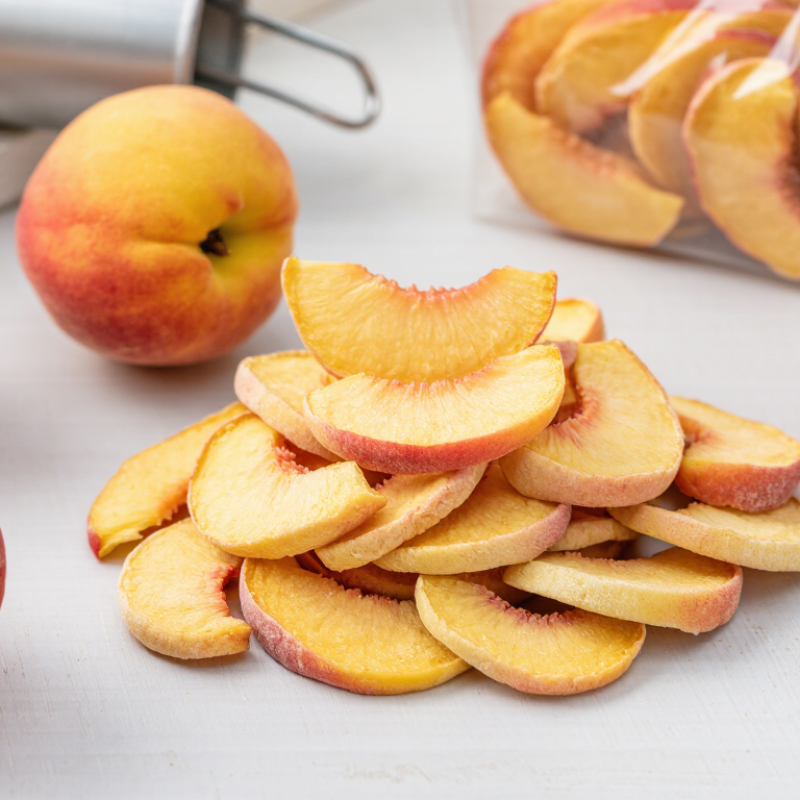
Freeze-dried peaches are commonly sold as whole halves, slices, diced pieces, granules, and powder. For bulk orders, define the form by dimensions and intended use: uniform 6–10 mm dice suit cereal blends, while intact slices create a visible topping. USDA FoodData Central reports about 88.9 g of water per 100 g of raw peach. Freeze-drying removes most of that water, and many commercial specifications target moisture below 5%. That figure is a purchasing target, not a universal grade rule.
Grades are often supplier-defined rather than interchangeable. Ask for written limits on color, size variation, broken pieces, foreign matter, and moisture, plus a recent certificate of analysis. Codex CXS 130-1981 covers conventionally dried peaches; buyers should not assume its criteria automatically apply to freeze-dried products. A pale piece is not necessarily defective, since cultivar and processing affect color. Still, moisture alone is not quality.
Tips: Request samples from the actual production lot. Check crispness after opening, then reseal the pouch and watch for softening. Handle gently. Compare powder and diced-product specifications separately, because particle size affects both dosing and texture.
China’s freeze-dried peach suppliers vary widely in scale, equipment, and export experience. Bulk buyers should compare usable monthly output, not just a factory’s stated annual capacity. Ask how many freeze-drying chambers operate, whether peach supply is seasonal, and how batches are scheduled. Capacity matters. High throughput can still mean delays when fresh fruit intake peaks or equipment needs maintenance. Request recent production records and a pilot lot before agreeing on a firm delivery window.
Certifications need close reading. Check current certificates, issuing bodies, covered facility addresses, product scope, and expiration dates. Requirements differ by destination, so confirm applicable food-safety and labeling rules with your importer. Export readiness also shows in practical details: lot-level traceability, moisture-barrier packaging, clear product specifications, and complete shipping documents. Ask for a recent certificate of analysis and compare its results with your purchase requirements. A tidy sample is not the whole story. Color and piece size may shift between harvests, and buyers should agree on acceptable tolerances in writing before placing a bulk order.
Use the seven Codex HACCP principles as a practical framework when assessing a supplier’s food-safety controls. The chart shows the sequence of the principles, not supplier scores, production capacity, or market statistics.
Source: Codex Alimentarius, General Principles of Food Hygiene (CXC 1-1969), HACCP system and guidelines for its application. Verify applicable certifications, audit records, capacity, and destination-market requirements directly with each supplier.
Freeze-Drying Basics: Ice Sublimation Below Water’s 611 Pa Triple-Point Pressure
Freeze-drying removes water from frozen peaches by turning ice directly into vapor. The key is keeping product temperature low while chamber pressure stays below water’s triple-point pressure. NIST reports the triple point at 273.16 K and 611.657 Pa. Above that boundary, liquid water can exist; below it, ice can sublime without melting. That distinction helps preserve peach slices’ shape, color, and aroma. The physics is simple. The process control is not.
In practice, operators freeze the fruit, reduce chamber pressure, and supply carefully controlled heat. Industrial freeze-drying references, including the ASHRAE Handbook—Refrigeration, describe low-pressure drying systems that support this transfer. The exact operating pressure varies with equipment, slice thickness, and product temperature; 611 Pa is a phase boundary, not a universal setpoint. A thick peach wedge and a thin slice do not dry alike. This is easy to overlook.
For bulk buyers, ask suppliers how they monitor product temperature, chamber pressure, and residual moisture. A dry-looking slice can still contain unevenly distributed moisture. NIST’s value is precise, but real batches are not perfectly uniform. That deserves a second look. My practical caution: compare samples from different parts of a lot, not only the brightest pieces on top.
| Category | Evaluation Dimension | Relevant Data or Requirement | What Bulk Buyers Should Check |
|---|---|---|---|
| Bulk Supplier and Product Evaluation | |||
| Product specification | Peach variety and origin | Variety, growing region, harvest season, and raw-material origin can affect color, flavor, and texture. | Request a written specification identifying the variety or variety group and the declared origin. |
| Product specification | Cut and format | Common formats include slices, diced pieces, chunks, and powder. Piece dimensions should be stated in the product specification. | Confirm dimensions, allowable breakage, fines, and whether the order is cut to a buyer-defined specification. |
| Quality control | Moisture and water activity | Moisture content and water activity are distinct measurements; limits should be agreed for the specific product and intended use. | Ask for the test methods, acceptance limits, and batch-specific certificate of analysis rather than relying on a general claim. |
| Quality control | Food safety documentation | Food safety controls and certification status vary by facility and market; no single certification should be assumed for every supplier. | Review current facility documents, product testing, allergen controls, traceability procedures, and applicable import requirements. |
| Packaging | Moisture and oxygen protection | Freeze-dried pieces are porous and can take up moisture; packaging integrity is important for preserving crispness and quality. | Specify the food-contact packaging, sealing method, pack size, storage conditions, and any agreed barrier requirements. |
| Commercial terms | Bulk order planning | Minimum order quantity, production lead time, sample availability, and shipment terms are supplier-specific and should be confirmed in writing. | Compare quotations on the same product specification, packaging basis, delivery term, and order quantity. |
| Verification | Samples and batch consistency | Color, aroma, sweetness, texture, and piece-size distribution can vary with fruit and processing conditions. | Approve a representative sample and define inspection criteria before placing a bulk order. |
| Freeze-Drying Basics | |||
| Phase behavior | Water triple point | Water’s triple point is approximately 611.657 pascals (Pa) at 0.01°C, where ice, liquid water, and water vapor can coexist. | This is a reference point for understanding why freeze-drying uses low pressure; it is not, by itself, a universal dryer setpoint. |
| Primary drying | Ice sublimation | In primary drying, frozen water is removed mainly by sublimation: ice changes directly into water vapor under reduced pressure. | Product temperature, chamber pressure, heat input, and layer thickness must be controlled for the product and equipment. |
| Secondary drying | Residual moisture removal | After most ice has been removed, secondary drying reduces remaining bound moisture, commonly by applying controlled heat under vacuum. | Confirm the finished-product moisture or water-activity specification and the test method used to verify it. |
| Storage | Protection after drying | Low-moisture freeze-dried foods can lose crispness when exposed to humid air. | Keep packs sealed and store them under the supplier’s stated conditions; protect opened material from ambient humidity. |
Note: Product limits, certifications, production capacity, prices, and lead times are supplier- and order-specific. Verify them against current documents and a written quotation before purchase.
For bulk buyers comparing China freeze dried peaches suppliers, water activity should be checked alongside moisture content. Moisture alone cannot show how much water is available for microbial growth. Ask for a lot-specific water activity result, the test method, and the instrument’s calibration record. Set an acceptance limit in the purchase specification before production. A reading near the limit deserves a repeat test, not a quick assumption. Small details matter.
Microbial checks should match the product, intended use, and destination-market requirements. Request results for relevant pathogens and indicator organisms from a qualified laboratory, with sample size and method stated. A clean certificate is useful, but it does not replace a defined sampling plan. For incoming goods, inspect sealed cartons and check for damp spots, clumping, or unusual odor. These signs do not prove contamination, yet they warrant a hold and follow-up. Testing every carton is rarely practical, so agree on risk-based sampling.
Traceability needs to work in both directions. Each case should carry a readable lot code linked to production dates, raw peach sourcing records, processing details, and packaging materials. Ask suppliers to demonstrate how quickly they can connect a carton to its test reports and shipment documents. Keep retained samples under suitable storage conditions for comparison if quality concerns arise later. Records can look complete on paper and still be hard to retrieve. Test the system before a large order, and document any gaps openly.
For bulk buyers comparing China freeze-dried peach suppliers, plan around the order size you can actually sell. Ask each supplier for its minimum order quantity by cut, grade, and package format. A low MOQ may apply only to standard stock, not a custom pouch or private label. Confirm this in writing. Request a sample from the same production specification you intend to order. Check color, crispness, piece size, and aroma; peach pieces can vary more than photos suggest.
Packaging affects shelf life, freight volume, and landed cost. Ask whether the peaches are packed in bulk-lined cartons or retail-ready pouches, and confirm net weight, carton dimensions, and protective inner liners. Compare lead times for samples, production, and dispatch separately. A quoted production window may not include packaging approval or shipping time. For landed cost, add product price, packaging, freight, insurance, customs-related charges, and any inspection fees. Use the same delivery terms and shipment assumptions when comparing quotations.
Tips: Get a dated quotation with MOQ, lead time, pack details, and payment schedule. Ask how delays or out-of-spec goods are handled. Keep a small buffer in your delivery plan; supplier estimates are useful, but rarely perfect.