
Choosing a Custard Jelly supplier is not just a price comparison. The product must arrive with consistent texture, clean flavor, dependable packaging, and clear specifications. A cup that looks smooth under bright showroom lights may separate after transport or feel grainy when chilled. Small details matter. Ask suppliers how they control ingredient variation, mixing, filling, and batch consistency. Request samples, then test them under the storage and serving conditions your customers will actually use.
Food safety deserves equal attention. The World Health Organization’s 2015 estimates associate contaminated food with 600 million illnesses and 420,000 deaths worldwide each year. That figure covers food broadly, not Custard Jelly specifically, but it underscores why supplier checks should go beyond a tasting session. Review quality records, product specifications, traceability procedures, and relevant food-safety certifications. Confirm that the supplier can explain how it handles complaints and investigates a failed batch. As WHO Director-General Dr. Tedros Adhanom Ghebreyesus has said, “Food safety, nutrition and food security are inextricably linked.” His point is relevant to everyday sourcing decisions. A low quote may look attractive; an unclear process is harder to justify. Even a polished sample can hide a weak production routine. The best choice is a supplier whose claims can be checked, whose products perform consistently, and whose team answers specific questions without evasion.
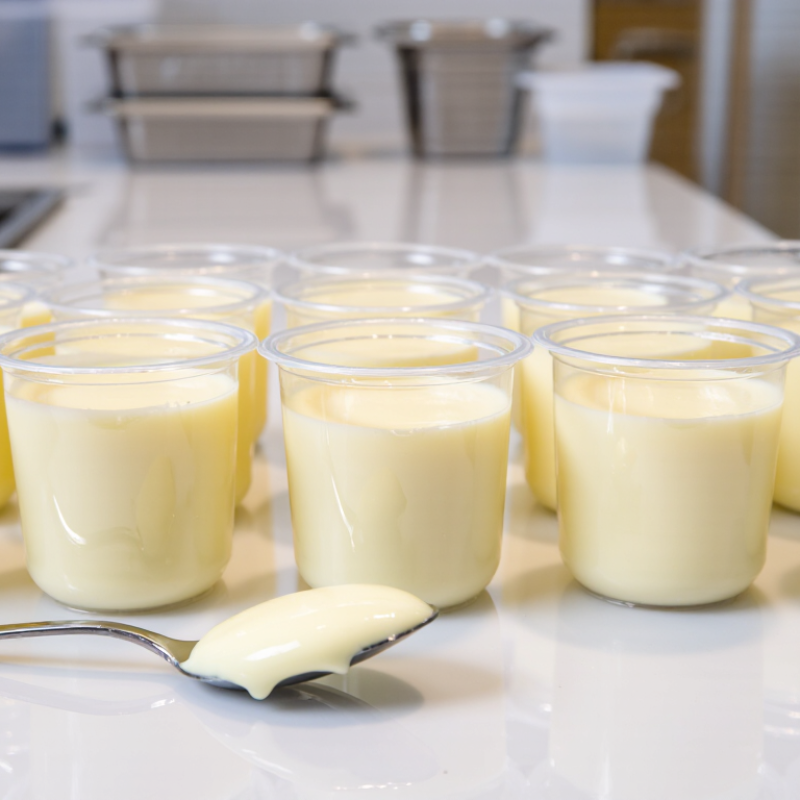
Before requesting quotes, define the custard jelly you need to serve, not just the flavor. Set a °Brix range to describe sweetness and soluble solids. For example, compare samples with the same refractometer and at a consistent temperature. °Brix alone does not predict whether a jelly will taste rich or feel sticky. Ask suppliers to report typical results and acceptable batch variation.
Specify a target pH and request a measured range for production lots. pH affects tartness and can influence texture, but it is not a stand-alone food safety check. Agree on the texture in practical terms: spoonable, clean-cutting, or softly elastic. If possible, compare samples using the same container, serving temperature, and simple firmness test. Small testing differences can change the result. That part is easy to overlook.
Serving conditions matter too. A dessert topping held cold needs different performance from jelly portioned into cups for transport. Tell suppliers about storage time, portion size, and whether the product will be layered, scooped, or eaten with a spoon. Request samples from more than one batch, then record °Brix, pH, texture, and tasting notes. There is no perfect specification for every menu; a firmer jelly may travel better but feel less delicate. Revise the targets after a real service trial.
Define custard-jelly specifications using °Brix, pH, texture, and serving requirements.
Illustrative soluble-solids targets by application (°Brix)
These example ranges are starting points for supplier discussions, not universal product standards. Confirm the °Brix range with sensory and shelf-life trials. In the purchase specification, also state the acceptable pH range, the texture test method and target, and serving conditions such as chilled or ambient use. Texture results are comparable only when the test method and conditions are defined.
When choosing a custard jelly supplier, look closely at how milk and egg risks are controlled. Custard commonly contains both, so ask how ingredients are received, stored, measured, and labeled. FDA recognizes nine major food allergens: milk, eggs, fish, crustacean shellfish, tree nuts, peanuts, wheat, soybeans, and sesame. A supplier may not use every one, but other allergens can still create cross-contact risks.
Request current ingredient specifications and sample package labels. Check that milk and egg are clearly identified, including in compound ingredients such as powders or flavor bases. Ask for written cleaning procedures, production schedules, and records showing how shared equipment is handled between runs. A clean-looking worktable is not enough. You need documented controls and a clear process for investigating mistakes.
Traceability matters, too. Ask whether the supplier can identify the production lot and relevant ingredient lots from a finished case. Confirm how quickly they can provide that information. One detail is easy to overlook: recipes and suppliers can change. Request notice of changes and updated documents before accepting a new formulation. Paperwork can feel repetitive, and it is not perfect proof; compare it with a facility review when practical.
When comparing custard jelly suppliers, ask to review the actual HACCP plan, not just a certificate. It should identify hazards in the supplier’s ingredients and process, including allergens, microbial growth, and physical contamination. Look for clear reasoning about which steps control each risk. A plan copied from another product may miss details such as custard cooking, filling, or cooling.
Codex’s seven principles should be visible in the records: hazard analysis, critical control points, critical limits, monitoring, corrective actions, verification, and documentation. Check that limits are supported by evidence and suit the supplier’s process. Monitoring should name who checks each control, how often, and what gets recorded. If a cooling check fails, the plan should explain how affected product is held and assessed. Vague instructions are hard to trust.
Ask for recent monitoring logs, calibration records, deviation reports, and verification results. These show whether the plan works on a busy production day, not only on paper. Paper is patient. A site visit can reveal practical gaps, such as an unlabelled rework container or incomplete cleaning records. I would not expect every document to be perfect; I would expect the supplier to explain gaps, make corrections, and keep evidence. Compare the written plan with what staff actually do, especially during ingredient changes and equipment cleaning.
| Codex HACCP Principle | What to Assess for Custard Jelly | Evidence to Request or Review | A Strong Assessment Indicator |
|---|---|---|---|
| 1. Conduct a hazard analysis | The plan identifies relevant biological, chemical, physical, and allergen hazards across ingredients, processing, filling, cooling, storage, and transport. Consider hazards associated with milk, egg, other declared allergens, and the product’s intended storage conditions. | Product description, process-flow diagram, hazard analysis, ingredient specifications, supplier approval records, and documented review of the process flow. | Hazards are evaluated for likelihood and severity, with a clear rationale for significant hazards and the controls used to prevent or reduce them. |
| 2. Determine the critical control points (CCPs) | CCPs are identified where control is essential for a significant hazard. Depending on the product and process, relevant steps may include heat treatment, cooling, or another validated control step. | CCP determination records, a decision-tree analysis or equivalent rationale, process-flow diagram, and supporting validation documents. | Each CCP is linked to a specific significant hazard, and the supplier explains why that hazard is controlled at that step rather than by another measure. |
| 3. Establish critical limits | Each CCP has measurable or observable limits that separate acceptable from unacceptable operation. Limits are specific to the supplier’s formulation, equipment, process, and product. | HACCP plan, process validation, equipment specifications, and records showing the basis for the chosen limits. | Limits are defined clearly and supported by scientific or technical validation. Codex does not prescribe one universal time-and-temperature limit for every custard jelly product. |
| 4. Establish a monitoring system | The plan states what is monitored at each CCP, how it is measured, how often monitoring occurs, and who is responsible. Where relevant, review monitoring of heating, cooling, or product temperature. | Monitoring procedures, completed production records, instrument identification, staff training records, and calibration records for relevant measuring equipment. | Monitoring can detect loss of control in time for action, and records are dated, attributable to trained staff, and reviewed by an authorized person. |
| 5. Establish corrective actions | Procedures explain what happens when monitoring shows that a critical limit was not met, including control of affected product and restoration of process control. | Corrective-action procedure, deviation and disposition records, investigation findings, and records of actions taken to prevent recurrence. | Affected product is identified and assessed before release or disposal, the cause of the deviation is investigated, and actions are documented. |
| 6. Validate the HACCP plan and establish verification procedures | The supplier verifies that controls work as intended and reviews whether the HACCP plan remains suitable when ingredients, formulation, equipment, process, or packaging changes. | Validation studies, verification schedules, internal audit findings, record reviews, calibration checks, and relevant environmental or product-testing results. | Verification activities are planned and recorded. Testing supports, but does not replace, effective process control and a validated HACCP system. |
| 7. Establish documentation and record keeping | Documents and records cover the HACCP plan, hazard analysis, CCP monitoring, deviations, corrective actions, verification, and relevant product and lot identification. | Controlled HACCP documents, production and release records, traceability records, retention policy, and examples of completed records. | Records are legible, retrievable, protected from unintended changes, and sufficient to trace a finished-product lot to relevant ingredients and processing records. |
Reference: Codex Alimentarius, General Principles of Food Hygiene, CXC 1-1969, including the HACCP system and guidelines for its application. Assess the supplier’s controls against the specific product, process, and applicable legal requirements.
When choosing a custard jelly supplier, ask how the product stays cold from packing through delivery. The FDA Food Code uses 41°F (5°C) as the cold-holding limit for time-and-temperature-controlled foods. It is a model code, so confirm which requirements your local authority has adopted. Do not rely on a supplier’s general assurance. Ask for temperature records covering storage, loading, transit, and handoff.
A useful delivery record shows when readings were taken and which instrument was used. Request calibrated probe or data-logger checks, not just a truck display reading. The air can be cold while a case near the door warms during a long stop. Check product temperature at receipt, inspect seals, and note any damaged or damp cartons. Small details matter. If a load arrives above the agreed limit, document it and follow a clear hold-or-reject procedure instead of putting it straight into service.
Ask how the supplier handles delays, equipment failures, and delivery windows. A written corrective-action plan should explain who is contacted and how affected lots are identified. Keep your own receiving log, even when the supplier sends one. Records can be incomplete; that is worth questioning. Also verify the product’s storage instructions, since formulation and packaging may affect handling. A brief trial delivery can reveal whether temperature checks fit your actual receiving routine.
Choose a supplier using evidence from your exact product, not a shelf-life figure copied from a similar dessert. Request the study protocol, packaging details, storage temperature, and test results for the custard jelly you plan to buy. The use-by period should match the actual recipe, sealed cup, and cold-chain conditions. Small details matter. FAO’s The State of Food and Agriculture 2023 estimated that 13.2% of food was lost between harvest and retail in 2021. That broader supply-chain figure is a reminder to check how a supplier controls handling and stock rotation, not a prediction of jelly losses.
Ask for a sample batch record showing ingredient lots, production date, and a code you can trace through dispatch. The FDA says firms handling foods covered by its Food Traceability Rule must provide requested records within 24 hours, or another agreed reasonable time; confirm whether the rule applies to your product and route. Compare minimum order quantities against a realistic launch forecast, storage space, and expected waste. Then request lead times for both routine orders and peak periods, including ingredient delays. It is easy to trust a polished schedule too much. Check recent delivery performance and agree how changes will be communicated.