Top 10 Types of Pet Food Machines to Buy?

Choosing the right pet food machine is rarely as simple as comparing prices or motor power. A small bakery producing soft dog treats needs different equipment from a factory making dry kibble. Moisture, recipe density, production volume, cleaning time, and available floor space all affect the decision.

Dr. Greg Aldrich, a respected pet food scientist, describes pet food as “a complex food system.” That observation matters when selecting machinery. A reliable line must protect ingredient quality while delivering stable texture, shape, moisture, and safety. In real production, even a minor temperature change can alter extrusion results. A poorly adjusted cutter may also create uneven pieces, leading to waste and inconsistent packaging.

This guide examines the top 10 types of pet food machine worth considering. The list includes grinders, mixers, extruders, dryers, coolers, coating systems, treat machines, and packaging equipment. Each machine serves a different stage of production. Some support homemade or small-batch operations. Others suit continuous industrial manufacturing.

Practical experience matters here. A high-capacity machine may look impressive, yet it can become expensive and inefficient for a growing workshop. Cleaning access is often overlooked. So is spare-parts availability.

Do not buy based on speed alone.

The right choice depends on your recipe, output target, workforce, and quality controls. No machine solves every production problem. Operators still need accurate measurements, regular maintenance, and careful inspection. This overview may not answer every situation, but it provides a clearer starting point for comparing equipment with fewer costly assumptions.
Top 10 Types of Pet Food Machines to Buy?

Pet Food Machinery Market Context: APPA Reports $150.6B U.S. Pet Spending in 2024

Top 10 Types of Pet Food Machines to Buy

The American Pet Products Association reports $150.6 billion in U.S. pet spending for 2024. This figure signals strong demand, but spending alone should not dictate a machine purchase. Production volume, recipe moisture, ingredient texture, and available floor space matter more in daily operations. From practical experience, the ten most useful machine types include grinders, mixers, steam conditioners, extruders, dryers, coolers, coaters, crushers, filling machines, and sealing machines. Each solves a different production problem.

A grinder reduces meat, grains, or vegetables into a consistent size. A mixer distributes nutrients evenly through the formula. Extruders shape dry food, while dryers control moisture and improve storage stability. Coolers protect product texture after heating. Coaters add oils or flavor components carefully. Crushers handle oversized pieces, although excessive crushing can create unwanted dust. Filling and sealing machines improve portion accuracy and protect packages. Metal detection equipment is also worth considering for quality control, even though it is not always counted among the core ten.

Tips: Match machine capacity to realistic output, not optimistic forecasts. Check cleaning access, temperature controls, spare-part availability, and operator training. Request test runs with your actual ingredients. Small details matter. I would also budget for downtime, because new equipment rarely performs perfectly on day one. A lower-cost machine may look attractive, but difficult sanitation can become expensive later. Keep written batch records and review them regularly. This supports traceability and helps reveal weak points before customers notice them.
How to Classify the Top 10 Pet Food Machines by Production Stage

Top 10 Types of Pet Food Machines to Buy?

The best way to classify pet food machines is by production stage, not by price or appearance. At the raw-material stage, a grinder reduces meat, grains, and dried ingredients to a controlled particle size. A weighing system then measures each ingredient accurately. A mixer blends the batch evenly, although uneven loading can still create nutrient variation.

During forming, a preconditioner adds water and steam before extrusion. The extruder cooks the mixture under pressure and shapes it into kibble. A cutter controls piece length. Small differences matter. Oversized pieces may dry unevenly or become unsuitable for smaller animals. Operators should check temperature, pressure, and moisture during every shift.

The finishing stage includes a dryer, cooler, coating machine, and packaging machine. The dryer removes moisture to support shelf stability, while the cooler prevents condensation inside bags. The coating machine applies oils or approved flavors after cooling. Packaging equipment controls weight and seals each bag. A metal detection system is also essential for routine quality control, making ten practical machine categories in total. A common planning mistake is choosing capacity before testing the recipe. Production trials, sanitation checks, and maintenance access should guide the final purchase. Even experienced teams sometimes underestimate cleaning time.

Top 10 Types of Pet Food Machines to Buy? - How to Classify the Top 10 Pet Food Machines by Production Stage

No. Machine Type Production Stage Primary Function Typical Materials or Products Common Operating Range Best Suited For
1 Raw Material Cleaner and Sieve Receiving & Preprocessing Removes dust, stones, metal fragments, oversized particles, and other foreign matter before grinding or mixing. Cereals, pulses, meat meal, fish meal, mineral premixes, and other dry ingredients. Commonly fitted with vibrating screens, aspiration channels, or magnetic separators. Dry kibble and treat plants
2 Hammer Mill or Pulverizer Size Reduction Reduces particle size to improve ingredient uniformity, mixing performance, and extrusion stability. Corn, wheat, rice, soybean meal, meat meal, and dried by-products. Screen selection commonly controls the final particle size; finer grinding is used for smaller products. Extruded kibble and powdered mixes
3 Batch or Continuous Mixer Ingredient Mixing Combines dry ingredients and distributes vitamins, minerals, fats, and other minor components evenly. Ground grains, protein meals, oils, premixes, fibers, and functional additives. Ribbon, paddle, and twin-shaft designs are commonly used for dry or liquid-assisted mixing. All complete and balanced formulas
4 Preconditioner Moisture & Thermal Conditioning Adds steam and water to hydrate the meal and partially cook starch before extrusion or forming. Mixed dry meal, water, steam, and selected liquid ingredients. Residence time, moisture level, and steam input are adjusted according to the formula. High-throughput extruded pet food
5 Twin-Screw Extruder Cooking & Forming Cooks, mixes, compresses, and shapes pet food through a die under controlled heat, moisture, and shear. Cereal-based meals, meat-containing formulas, legumes, fibers, and water or steam. Die shape, screw configuration, moisture, temperature, and pressure determine product texture and density. Dry kibble and expanded treats
6 Wet Pet Food Cooker and Filler Wet Food Processing Cooks a meat-based formulation and doses it into cans, trays, pouches, or other heat-processable containers. Meat, fish, broth, cereals, vegetables, gelling agents, and gravy or jelly systems. Filling accuracy and thermal-process compatibility depend on product viscosity and container type. Canned, tray, and pouch food
7 Kibble Cutter and Shaper Sizing & Product Forming Cuts extruded strands and produces controlled shapes, lengths, and portions for kibble or treats. Freshly extruded dough, semi-moist dough, and shaped treat mixtures. Cutting speed, die geometry, and knife adjustment influence piece size and shape consistency. Different pet sizes and shaped treats
8 Dryer and Cooler Moisture Control Lowers moisture after cooking and then cools the product before coating, inspection, and packaging. Extruded kibble, biscuits, baked treats, and other formed dry products. Air temperature, airflow, belt loading, and residence time are controlled to protect product quality. Shelf-stable dry products
9 Coating and Flavoring Machine Post-Processing Applies oils, fats, palatants, powders, or nutritional coatings evenly to the surface of finished kibble. Dry kibble, edible oils, animal-fat coatings, liquid palatants, and powdered supplements. Spray rate, drum or tumbler speed, and product flow determine coating uniformity. Improving palatability and energy density
10 Weighing, Packing, and Sealing Machine Packaging & Dispatch Weighs the finished food, fills bags or pouches, seals the package, and may apply date or batch coding. Dry kibble, treats, powder supplements, pouches, bags, and preformed containers. Multihead weighers, auger fillers, or volumetric systems are selected according to product flowability. Retail and bulk package formats

Note: Actual capacity, moisture targets, temperature, and configuration vary according to the recipe, product format, packaging material, and required production volume.

Top 10 Machine Types: Processing, Forming, Drying, Coating, and Packaging

Top 10 Types of Pet Food Machines to Buy?

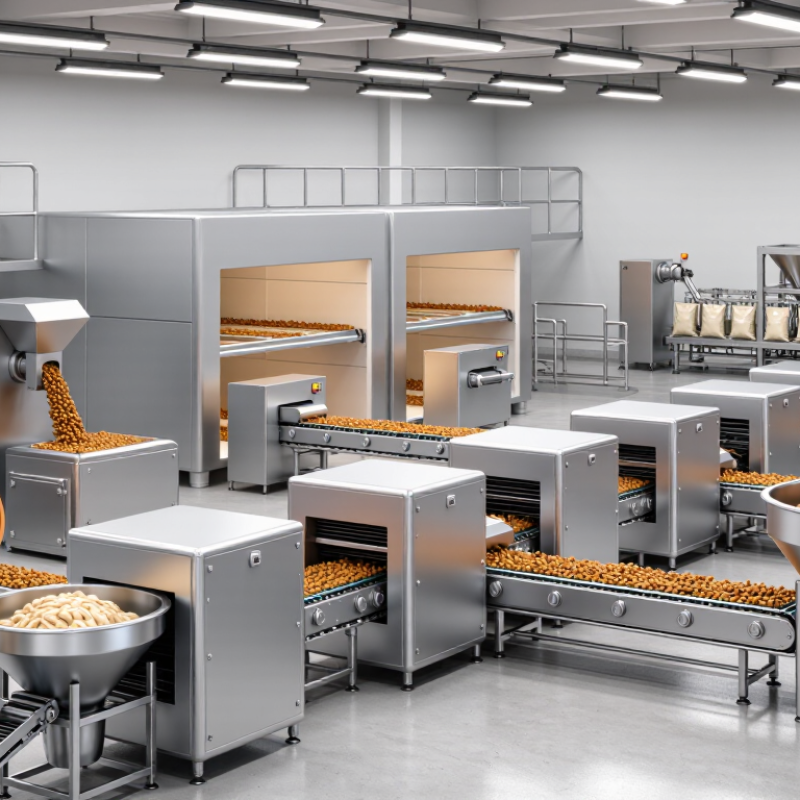
Choosing pet food machinery should follow the production process, not a sales catalogue. A hammer mill reduces ingredients to a consistent size, while a ribbon mixer distributes powders and oils evenly. A steam cooker improves starch preparation before forming. A twin-screw extruder then shapes cooked food under controlled pressure and temperature. Moisture readings matter here. Small changes can affect texture, density, and digestibility.

Forming may also require a rotary cutter for uniform kibble pieces or a molding machine for soft treats. After shaping, a belt dryer lowers moisture through controlled airflow and heat. Overdrying can waste energy and create brittle products. Underdrying can shorten shelf life. I would check several points across each batch, not only the first sample. That is where real production often exposes weak settings.

Coating comes next. A coating drum can apply oils or nutritional liquids across the surface, while a vacuum coater helps improve absorption and reduce uneven spots. Packaging completes the ten machine types. A weighing and sealing machine should handle accurate portions, clean seals, and traceable batch information. Operators should inspect contact surfaces, drainage areas, and emergency stops daily. Easy cleaning is valuable, but it is not automatic. Some equipment looks efficient until changeovers become slow. Ask for test runs using your actual recipe, moisture level, and package size. My choice might still change after that trial.

Top 10 Types of Pet Food Machines to Buy

The chart compares indicative nominal throughput bands for common pet food machinery used in processing, forming, drying, coating, cooling, screening, and packaging. Actual capacity varies with recipe, moisture level, product shape, equipment configuration, and operating conditions.

Capacity is shown in approximate kilograms per hour and is intended for preliminary equipment comparison rather than final machine selection.

Buying Metrics: Throughput, Energy Use, Automation, and HACCP Compliance

Top 10 Types of Pet Food Machines to Buy?

Pet food production may require grinders, mixers, extruders, dryers, coaters, coolers, fillers, and packaging machines. Each type affects throughput, energy use, automation, and HACCP control. A higher capacity rating is not always better. If the line runs half-empty, energy costs and cleaning time can rise. Compare hourly output using your actual recipe, moisture level, and batch size.

Energy meters should measure each major machine, not only the whole factory. Variable-speed drives can reduce waste during slower production periods. Automation may improve dosing accuracy, temperature control, and operator safety. However, complex systems can create expensive downtime without trained technicians. Ask for maintenance records, spare-part availability, and realistic changeover times. These details often matter more than impressive brochures. I have found that a small manual step can sometimes protect quality better than poorly configured automation.

Tips: Request a trial with your own ingredients. Check whether sensors record critical temperatures, moisture, and metal detection results. HACCP-ready equipment should support cleanable surfaces, controlled access, traceable batches, and documented verification. Inspect corners, seals, drains, and product-contact areas in person. Do not assume “food-grade” means fully compliant. Review sanitation procedures with a qualified food-safety professional, because local requirements and facility risks can differ.

Cost and Compliance: Compare ROI with FDA and AAFCO Manufacturing Standards

Top 10 Types of Pet Food Machines to Buy?

Cost and Compliance: Compare ROI with FDA and AAFCO Manufacturing Standards

Choosing pet food equipment requires more than comparing purchase prices. The ten common categories include grinders, mixers, extruders, dryers, ovens, coolers, coaters, fillers, sealers, and labelers. Each machine affects production speed, product consistency, sanitation, and labor costs. A small mixer may suit trial batches, while an extruder supports higher-volume dry food production. The right choice depends on recipe, moisture level, capacity, and planned growth.

Compliance must shape the investment from the beginning. In the United States, FDA requirements can involve current good manufacturing practices, hazard analysis, preventive controls, sanitation, and accurate records. AAFCO publishes model regulations, ingredient definitions, and labeling guidance; individual states may adopt these rules differently. Therefore, buyers should confirm requirements with qualified regulatory professionals and state authorities. Equipment should have cleanable surfaces, controlled temperatures, accessible inspection points, and documented maintenance procedures.

ROI should include installation, utilities, training, cleaning time, validation, repairs, and downtime. For example, an efficient dryer may reduce moisture-related spoilage but increase energy costs. A low-cost filler can create weight variation and waste. That choice may look cheap only on paper. I would also question optimistic capacity claims, because real output falls during changeovers and sanitation. Request test runs using your formula, review calibration records, and calculate cost per saleable unit. Compliance is not a final inspection step. It is part of the machine’s total value.