Top 10 Cooling Tower Types You Need to Know About?
cooling towers play a crucial role in various industrial processes. These structures dissipate heat from water used in cooling systems. According to Dr. Emily Carter, a leading expert in thermal engineering, “Understanding different cooling tower types is essential for efficient design.”
In this article, we explore the top 10 cooling tower types you need to know about. Each type has unique features and applications. Some models are highly efficient, while others may require more maintenance. Dr. Carter emphasizes that “the right choice can lead to significant energy savings.”
Choosing the correct cooling tower type is not always straightforward. Factors like location, climate, and usage must be considered. Even experienced engineers can face challenges. This article aims to shed light on these complexities and guide you in making informed decisions.
Types of Cooling Towers Based on Design and Structure
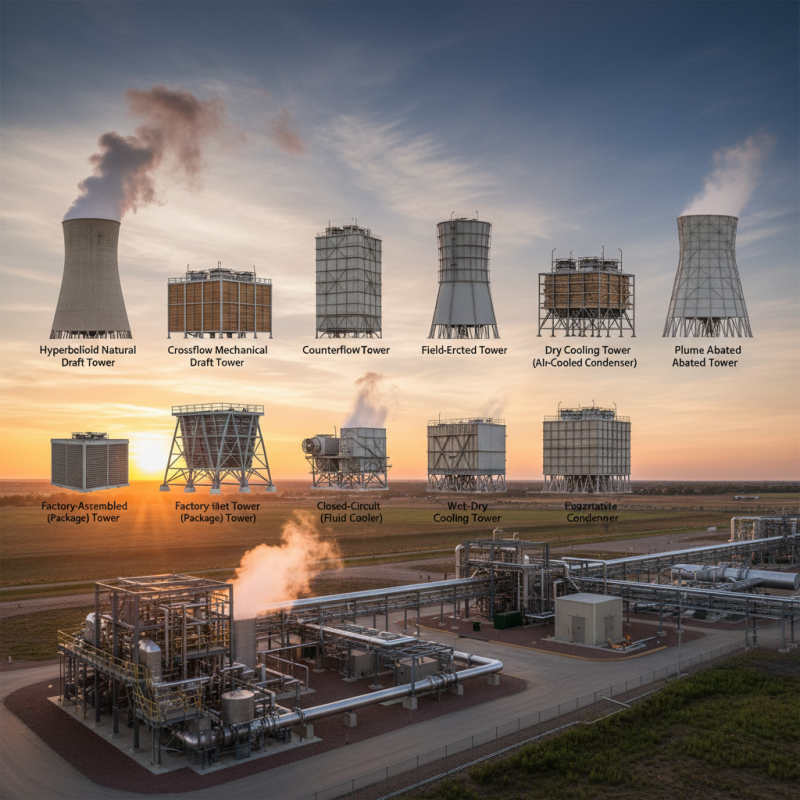
Cooling towers are vital in many industries, providing efficient heat dissipation. Their design and structure influence performance significantly. There are two primary types based on these aspects: natural draft and mechanical draft cooling towers.
Natural draft cooling towers rely on the buoyancy of warm air. They can be quite tall and have a distinctive hyperbolic shape. This design allows for airflow without the need for fans. However, their size can be a drawback, leading to higher construction costs. On the other hand,
mechanical draft cooling towers utilize fans to enhance air circulation. These towers are generally more compact. They are often found in urban areas where space is limited.
Another notable type includes
crossflow cooling towers. These feature a design where water flows horizontally, and air enters vertically. This arrangement improves heat exchange efficiency but may require more maintenance.
Counterflow cooling towers push air upward through the falling water. They tend to offer better cooling performance but can be less efficient in certain conditions. Each design comes with its own set of advantages and disadvantages. Understanding these can guide better choices in cooling tower applications.
Natural Draft vs. Mechanical Draft Cooling Towers
Natural draft and mechanical draft cooling towers serve crucial roles in industrial processes. Natural draft towers rely on buoyancy. They take advantage of temperature differences. Warm air rises and creates a draft. This design often results in lower operational costs. However, natural draft systems require significant space. They may not be practical for all facilities.
Mechanical draft towers use fans to enhance airflow. These systems can be more compact. They provide better control over temperature and can operate efficiently in confined spaces. Typically, they have higher energy consumption. According to a report from the Cooling Tower Institute, mechanical draft cooling towers can improve energy efficiency by 10-15% compared to older designs. This is crucial for industries aiming to reduce their carbon footprint.
Yet, choosing between the two types isn't straightforward. Sites with limited space may opt for mechanical draft options. They may appreciate the controllability, but the energy consumption remains a drawback. Conversely, facilities with open spaces might benefit from natural draft cooling. There’s always the challenge of varying climates affecting efficiency. Assessing these factors requires careful consideration.
Crossflow and Counterflow Cooling Towers: Key Differences
Cooling towers are essential in industrial and commercial settings. Among these, crossflow and counterflow cooling towers stand out. Understanding the differences can help in making informed choices for various applications.
Crossflow cooling towers allow air to move horizontally across falling water. This design promotes efficient heat exchange. The water distribution system often has nozzles that create a fine spray, maximizing contact with the air. Maintenance can be tricky, as debris may accumulate on the fill. Polluted water may hinder performance, leading to potential inefficiencies.
Counterflow cooling towers operate with air flowing vertically upwards against the downward-moving water. This design typically occupies less space than crossflow models. The mathematical efficiency can be surprisingly high. However, they require regular checks for fan and motor efficiency. Over time, the additional pressure can create noise issues, prompting further investigation. Choosing between these types depends on specific project needs and space availability.
Hybrid Cooling Towers: Combining Benefits of Both Types
Hybrid cooling towers are gaining attention in many industries. They combine the benefits of both wet and dry cooling systems. This type ensures efficient cooling while reducing water consumption. According to a report by the International Journal of Thermal Sciences, hybrid towers can achieve energy savings of up to 30% compared to traditional cooling methods.
These towers utilize both evaporation and air cooling. When ambient conditions are favorable, they operate in dry mode, minimizing water usage. When efficiency is at risk, they switch to wet mode, maximizing cooling. A study conducted by the Department of Energy found that hybrid systems can reduce operational costs significantly, yet they may require higher initial investments.
While hybrid cooling towers offer innovation, they also pose challenges. Maintenance can be complex, needing trained personnel. Sensors and controls must be expertly calibrated. Neglecting this may lead to inefficiencies. Despite their potential, not all facilities may benefit equally from hybrid solutions. Each operation should consider its unique requirements before transitioning.
Top 10 Cooling Tower Types You Need to Know About
This chart represents the efficiency ratings of various types of cooling towers. Hybrid cooling towers score the highest on the efficiency scale, combining elements from both crossflow and counterflow designs. Understanding these types helps in selecting the right cooling solution for specific applications.
Applications and Industries for Different Cooling Tower Types
Cooling towers play a crucial role in various applications and industries. These structures are essential for heat dissipation in systems like power plants, chemical factories, and HVAC setups. Each cooling tower type suits specific needs. For example, open cooling towers are common in industrial processes. They efficiently draw water from a reservoir while facilitating high evaporation rates.
Closed cooling towers, on the other hand, cater to more sensitive applications. They are ideal for cooling delicate machinery without exposing water to contaminants. This feature is vital in data centers and pharmaceutical facilities. As industries evolve, understanding the right type of cooling tower becomes crucial.
Tip: Always assess your water quality before choosing a cooling tower. A mismatch can lead to maintenance issues.
Caution is necessary. Open towers can be susceptible to external factors. For instance, if not managed well, they might accumulate biofilm or debris. This can affect efficiency and lead to costly repairs.
Tip: Regular inspection and upkeep help in preserving performance. Evaluate the environmental conditions surrounding your cooling tower too. This will assist in ensuring optimal operation for years to come.