Choosing the best pet food machine in 2026 requires more than comparing prices or impressive production figures. The American Pet Products Association’s 2025 State of the Industry report places U.S. pet industry spending above $150 billion in 2024. Meanwhile, Mordor Intelligence identifies continued investment in automated pet food processing equipment. Demand is rising. So is the cost of a poor decision.
A suitable machine must match your recipe, output, facility, and quality system. Check hourly capacity, twin-screw performance, moisture control, drying accuracy, energy use, and cleaning access. A stainless-steel frame looks reassuring, but hidden corners can retain residue. Ask for production trials using your actual ingredients. Corn-heavy formulas may behave very differently from meat-rich or sensitive diets. Supplier training, spare-parts availability, documentation, and validated safety procedures also matter. A machine that runs quickly but creates inconsistent kibble is not efficient.
Dr. Greg Aldrich, a recognized pet food scientist, has stated, “The process matters as much as the ingredients.” That principle should guide every purchase. The best pet food machine is not automatically the largest or newest model. It is the one that delivers stable texture, accurate moisture, reliable sanitation, and repeatable output. No machine is perfect. Brochures rarely show stoppages, difficult cleanouts, or operator learning curves. This guide examines those practical weaknesses, using industry data and production-focused criteria to help manufacturers make a more defensible choice in 2026.
How to Choose the Best Pet Food Machine in 2026?
Define Your Pet Food Production Needs and Goals
A suitable machine begins with a clear production brief, not a glossy specification sheet. The APPA 2024 State of the Industry report valued U.S. pet food and treats at about $65.8 billion. That scale creates opportunity, but demand alone cannot define your equipment.
Record the target species, recipe types, daily output, moisture range, and package sizes. Kibble may require extrusion, drying, coating, and cooling. Wet food needs controlled mixing, filling, sealing, and thermal processing. Treats can demand different forming pressures and temperatures. Also estimate peak capacity, not only today’s average. FEDIAF’s 2024 facts report counted approximately 299 million pets in Europe, showing how varied regional demand can be. A machine designed for one stable recipe may struggle with frequent changeovers.
Tips: Build a simple process map. Measure each step. Ask for verified throughput using your own ingredients. Check cleaning access, spare-part availability, operator training, energy use, and data logging. Request trial production before purchase.
My early equipment shortlist was too narrow. I focused on hourly output and ignored downtime during cleaning. That was a costly assumption. Consider future recipes, but avoid paying for unused complexity. Review HACCP controls, feed-safety documentation, and applicable local requirements with qualified specialists. No machine removes the need for disciplined testing. Even experienced teams can underestimate texture variation, especially when natural ingredients change between batches.
How to Choose the Best Pet Food Machine in 2026?
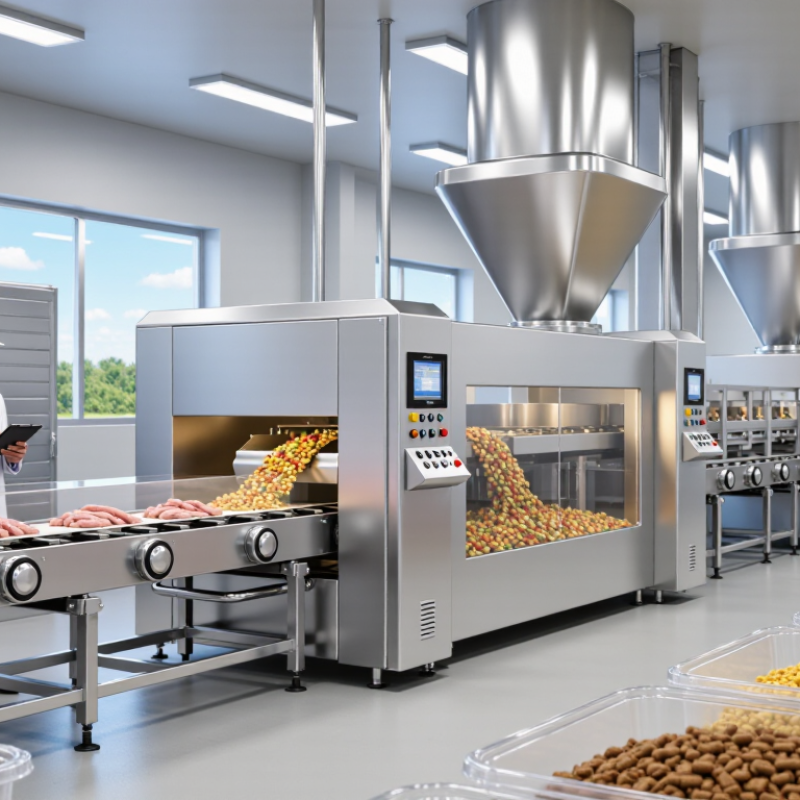
Machine selection should begin with product type, not price. Dry kibble usually requires an extruder, dryer, coater, and cooler. Wet food needs mixing, filling, sealing, and retort equipment. Treat production may need a forming machine and precise temperature control. Grand View Research valued the global pet food market at about USD 103 billion in 2023, with continued growth expected through 2030. This growth increases demand for flexible production lines, but bigger equipment is not automatically better.
Compare capacity with your actual sales plan. Small facilities often need 50–200 kilograms per hour. Growing factories may require 200–1,000 kilograms per hour, while industrial lines can exceed one tonne hourly. Check whether the stated capacity applies to dry or wet material. It may not. Important features include food-grade stainless steel, adjustable die systems, moisture sensors, automated temperature controls, and easy-clean surfaces. The FEDIAF 2024 report recorded 299 million pets in Europe, showing the scale of demand, but regional preferences still differ. A machine designed for one recipe may perform poorly with another.
Tips: Request test runs using your real formula. Measure energy use, changeover time, cleaning water, and product loss. Ask for maintenance records and operator training. APPA reported US pet industry spending of USD 152 billion in 2024, yet premium products often require smaller batches and tighter control. Choosing maximum capacity alone can create waste. Recheck the numbers before signing.
Compare common pet food machine types by typical production capacity and process suitability. Actual output depends on formulation, moisture, raw materials, die size, and operating conditions.
Key takeaway: Dry extruders generally provide the highest throughput for expanded kibble, while cold-forming and wet-processing systems are better suited to specialized recipes, softer textures, and lower-temperature production.
How to Choose the Best Pet Food Machine in 2026?
Material selection directly affects hygiene, durability, and food quality. Choose food-contact parts made from corrosion-resistant stainless steel. Check welds, corners, and internal surfaces carefully. Rough seams can trap grease and bacteria. Seals should resist heat, oils, and repeated cleaning. Plastic components need clear food-contact documentation. Do not rely on a polished appearance alone. It may hide weak joints or difficult cleaning areas.
Safety requires more than emergency buttons. Look for guards, overload protection, stable temperature controls, and accessible shut-off switches. Ask for test reports and documented compliance with applicable safety and food-contact requirements. A strong supplier should explain maintenance intervals, cleaning procedures, and traceability records. HACCP-based controls and recognized quality systems can support safer production, but certificates cannot replace daily inspections. Operators still need practical training.
Food quality depends on controlled processing. The machine should manage temperature, moisture, pressure, and mixing time consistently. Uneven heating may reduce nutrient stability or create dry and soft pieces in one batch. Request sample testing for texture, moisture, shape, and nutritional consistency. Watch the machine during a full cleaning cycle. That often reveals problems brochures ignore. Energy use, downtime, and changeover speed also matter. My own evaluation would not stop at specifications; real production conditions can expose uncomfortable weaknesses. A machine that looks efficient may become costly when cleaning takes twice as long.
| Evaluation Dimension | Dry Kibble Extruder | Wet Food Cooker and Filler | Treat Depositor or Forming Machine | Recommended Selection Criteria |
|---|---|---|---|---|
| Product Application | Expanded dry kibble and cereal-based pet food | Canned, pouched, loaf-style, and high-moisture pet food | Soft treats, biscuits, dental chews, and shaped snacks | Match the machine to the product’s moisture level, shape, recipe, and required throughput. |
| Preferred Food-Contact Material | 304 stainless steel is generally suitable; 316 stainless steel is preferable in high-salt, acidic, or corrosive environments. | 316 stainless steel is often preferred for frequent exposure to moisture, salt, and acidic ingredients. | 304 stainless steel for standard use; use corrosion-resistant alloys where acidic ingredients or aggressive cleaning chemicals are present. | Request material certificates and verify that every food-contact surface is suitable for the intended ingredients and cleaning chemicals. |
| Surface Finish and Hygienic Design | Smooth, polished surfaces; minimized dead zones; enclosed bearings and protected drive components. | Continuous welds, sloped surfaces for drainage, sanitary seals, and minimal product-retention areas. | Non-stick product-contact surfaces, removable tooling, and easy access to scraper and conveyor areas. | Avoid cracks, exposed threads, sharp internal corners, hollow frames, and inaccessible spaces that can retain food residue. |
| Typical Thermal Conditions | Cooking inside the extruder commonly uses elevated temperature and pressure; final drying is required to achieve shelf-stable kibble. | Thermal processing parameters depend on recipe, package size, and validated process requirements. | Usually operates at lower temperatures before baking or dehydration, depending on the treat formula. | Choose a system with calibrated temperature sensors, automatic recording, alarms, and recipe-based control. |
| Moisture and Food Quality Control | Control moisture, density, expansion, shape, and final water activity to support texture and storage stability. | Control fill weight, seal integrity, cooking conditions, viscosity, and water activity where applicable. | Control portion weight, thickness, shape, bake profile, texture, and moisture uniformity. | Use calibrated scales and validated laboratory or in-process tests; water activity is commonly used to assess microbial stability. |
| Cleaning and Sanitation | Dry cleaning may reduce water-related corrosion, but scheduled wet sanitation is needed for suitable components and areas. | Designed for frequent wet cleaning, with drainable frames, hygienic hoses, sanitary pumps, and compatible seals. | Quick-release dies, removable belts or trays, and tool-free access improve sanitation and changeover speed. | Confirm cleaning procedures, chemical compatibility, disassembly time, drying requirements, and sanitation verification methods. |
| Food Safety Management | Should support hazard analysis, allergen control, foreign-material prevention, and traceable process records. | Requires strict control of raw materials, thermal processing, filling, sealing, cooling, and storage conditions. | Requires control of allergens, raw-meat handling where applicable, baking or drying, and post-process contamination. | The equipment should fit a HACCP-based food safety plan and support applicable prerequisite programs. |
| Relevant Standards and Compliance Areas | Food-contact material requirements, machinery guarding, electrical safety, sanitation design, and applicable local regulations. | Food-contact material requirements, pressure and thermal safety where applicable, packaging integrity, and machinery safety rules. | Food-contact material requirements, guarding for moving parts, electrical safety, and hygienic design requirements. | Look for documented conformity with applicable regulations, HACCP or ISO 22000-based systems, and recognized machinery-safety requirements. Certification must be verified for the specific model. |
| Operator Safety Features | Interlocked guards, emergency stops, pressure protection, overload protection, and safe access for die changes. | Interlocked doors, emergency stops, protection from hot surfaces, pressure controls, and safe access to pumps and fillers. | Guarded forming tools, emergency stops, pinch-point protection, and safe access to conveyors and cutters. | Verify risk assessment documents, emergency-stop testing, lockout/tagout provisions, guarding, and operator training materials. |
| Production Flexibility | Flexible through interchangeable dies, recipe control, and adjustable cutter speed; changeovers may require cleaning and tooling changes. | Flexible through adjustable filling volume, recipes, dosing systems, and package formats. | Flexible when dies, molds, cutters, and conveyor settings can be changed quickly and repeatably. | Evaluate the number of recipes, format changes, tooling cost, changeover time, and cross-contamination controls. |
| Quality Verification Before Purchase | Request a recipe trial and test density, moisture, water activity, dimensions, texture, and nutrient uniformity. | Request a filling and thermal-process trial; test net weight, seal strength, package integrity, and microbiological stability. | Request a forming and baking trial; test dimensions, weight variation, texture, moisture, and breakage rate. | Accept the machine only after documented trials using the actual ingredients, target recipe, packaging, and cleaning method. |
| Best Choice for 2026 | Best for stable, high-volume dry-food production with strong control of expansion and drying. | Best for high-moisture products where validated thermal processing and hygienic filling are critical. | Best for varied treat portfolios requiring frequent shape, size, and recipe changes. | Prioritize hygienic design, verified food-contact materials, measurable safety controls, data logging, efficient cleaning, and proven product trials over nominal capacity alone. |
Note: Performance ranges and compliance requirements vary by recipe, jurisdiction, machine configuration, and installation conditions. Confirm current legal requirements and obtain model-specific technical documentation before purchase.
Choosing the best pet food machine in 2026 requires more than checking hourly output. In my equipment evaluations, automation often decides whether production feels controlled or chaotic. Look for automatic feeding, temperature control, moisture adjustment, and fault alarms. These features reduce repetitive work and protect batch consistency. A clear touchscreen helps operators change recipes without guessing. It matters during a busy shift. Still, excessive automation can confuse new staff. Ask for a live demonstration, not only a sales video. Check whether settings are recorded and traceable.
Energy use deserves a practical test. Compare power consumption per kilogram, not just motor wattage. A machine that heats quickly may still waste energy during long idle periods. Insulated chambers, efficient motors, and standby controls can lower operating costs. Request measured data from similar production volumes. Estimates are not enough. Maintenance should be simple and safe. Inspect access doors, removable dies, lubrication points, and cleaning areas. Food-contact parts should resist corrosion and allow thorough sanitation. I have seen impressive machines lose time because one small seal was difficult to replace.
Ease of operation also depends on training. Can a new operator understand the controls in one afternoon? Can the machine restart safely after a power interruption? Test noise, cleaning time, changeover steps, and spare-part availability. Do not ignore awkward details. I may overvalue technical specifications sometimes. A machine may perform well in a showroom but frustrate workers every day. Record your own trial results before committing.
How to Choose the Best Pet Food Machine in 2026?
Pet food demand is expanding, but machine purchases still require careful arithmetic. The American Pet Products Association reported U.S. pet food and treat sales of $65.8 billion in 2024. That figure supports investment, but it does not guarantee rapid payback. Compare purchase price, installation, energy use, labor, cleaning time, spare parts, and rejected batches. A cheaper machine may consume more electricity or need frequent adjustments. I have seen impressive demonstrations hide expensive maintenance routines. That mistake is easy to repeat.
Supplier quality matters as much as machine capacity. Request verified throughput data for your actual ingredients, not only laboratory samples. Review service response times, operator training, documentation, and parts availability. Warranty terms should clearly cover motors, controls, heating systems, and workmanship. The Food and Agriculture Organization highlights feed safety and process control as essential to consistent production. Therefore, check temperature records, sanitation access, and traceability features before signing. Grand View Research estimated the global pet food market at over $100 billion in 2023, showing strong opportunity, but not every factory needs maximum output.
Tips: Build a three-year total-cost model. Test a small production run. Ask for customer references. Calculate downtime costs. Negotiate training and critical spare parts in writing. Leave room for uncertainty; ingredient changes can reduce real output, and my first estimate would probably be too optimistic.